
'Last Week I Watched a Healthy Labrador Get Put Down for Something Completely Preventable. Here's What His Owner Wishes She Had Known.'
A veterinarian's open letter to senior dog parents about the joint deterioration timeline most owners discover far too late — and the $8,000 surgical bills that follow.

By Dr. James Patrick, DVM | 15 Years in Veterinary Practice | Vet Watch Insider
Published June 11, 2026 · 412,890 reads
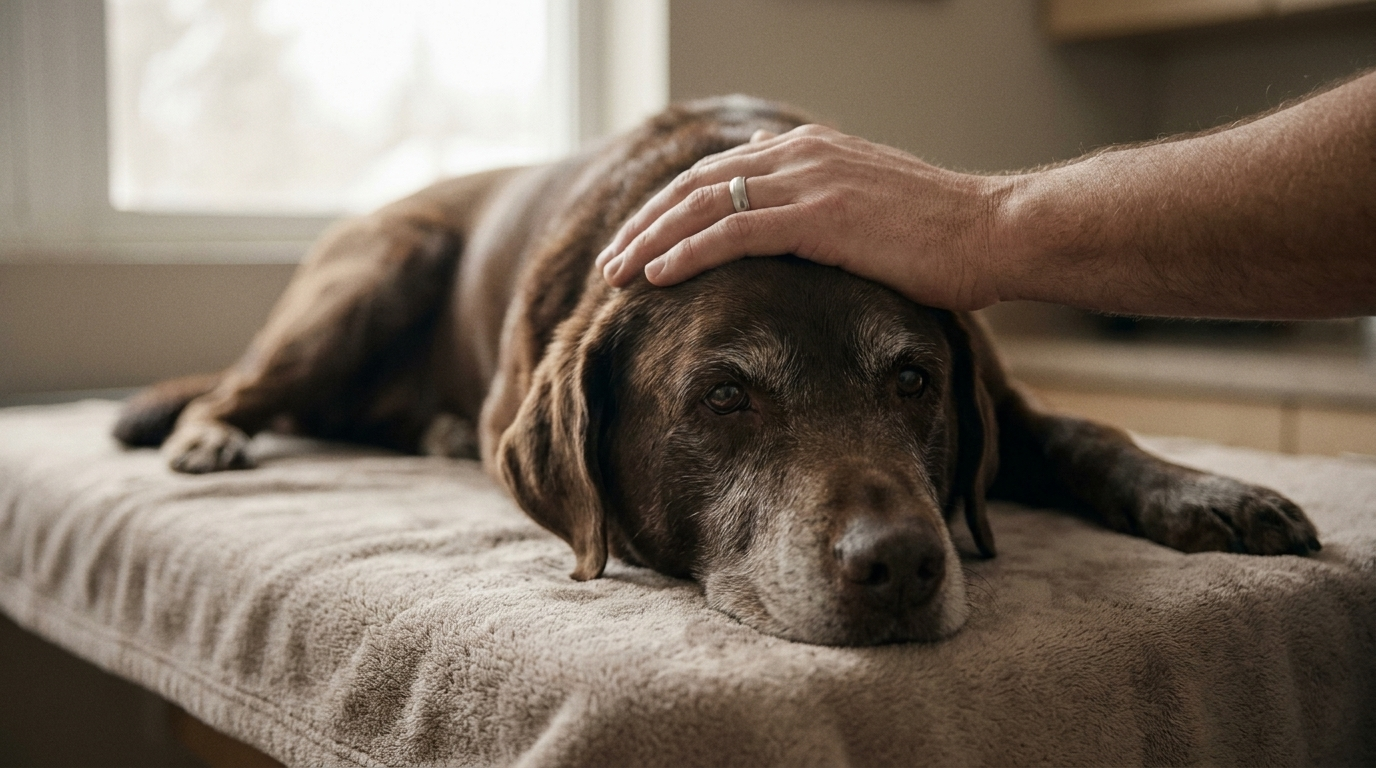
I don't want to write this article. I've put it off for three weeks. But last Tuesday I stood in my exam room and watched a 10-year-old yellow Labrador named Toby take his last breath, and I keep thinking about it every single night.
His owner, Patricia, was holding his head in her lap and apologizing to him through her tears. Apologizing. To her own dog. For something she had no way of knowing was going to happen until it was already too late.
Toby died because his joints failed completely. Severe bilateral hip dysplasia, advanced osteoarthritis, and by the time the pain became unmanageable, the surgical options were either prohibitively expensive or carried risks his liver couldn't tolerate after years of NSAID management.
And here's the part that keeps me up at night: it was almost entirely preventable. Not theoretically. Not "in an ideal world." Actually preventable, with interventions Patricia could have started six years ago for the cost of a couple of cups of coffee a week. But nobody told her clearly enough. Including, I'm ashamed to admit, me — when she first brought Toby in for a wellness visit at age 4.
So I'm writing this for every senior dog parent who still has time. Because the window for doing something about it is smaller than you think.
"Patricia did everything she thought was right. She loved that dog. She just didn't understand the timeline until it was too late. That's what I want to fix with this article."
Let me walk you through exactly what happens when canine joint deterioration isn't addressed early. This is going to be uncomfortable to read. But you need to see the whole timeline so you can make informed decisions about the dog you love.

Free shipping over $50 · 30-Day Money-Back · Cancel Anytime
What Patricia Wishes She Had Known About Toby
Patricia first brought Toby to me when he was 4 years old — a glossy, athletic yellow Lab who could swim for hours and out-fetch any dog at the park. At that visit I mentioned, in the way vets do when we're trying not to alarm anyone, that Labradors are a high-risk breed for hip dysplasia and osteoarthritis, and that prophylactic joint support is a smart idea for large breeds starting at age 3-4.
Patricia nodded politely and said something I've heard hundreds of times: "He doesn't seem to need one. He's still running around like a puppy."
That's the trap. That's the exact trap. Because by the time a dog seems to need joint support, the prevention window has usually already closed.
When Toby was 6, Patricia brought him in because he was "a little slower getting up." I examined him and felt the early crepitus in his hips — that gritty, grinding sensation under my fingers that means cartilage is already breaking down. I explained that prevention had to start before symptoms became visible, and I recommended a joint supplement. She said she'd "think about it."
When Toby was 8, she came back. He was limping after walks now and reluctant to climb stairs. We did x-rays. By then, the cartilage damage was already at stage 3 of a 4-stage disease progression. We started him on Carprofen (an NSAID) for pain management and a basic joint supplement, but I had to be honest with her: we were now managing decline, not preventing it.
By 10, the Carprofen had begun to affect his liver enzymes. We tried to taper. The pain came roaring back. With large-breed osteoarthritis, it's not a question of if — it's a question of when. A total hip replacement would have cost Patricia $7,800 — and even that wouldn't have fixed the liver damage we were already trying to slow.
Patricia made the only humane decision she could.
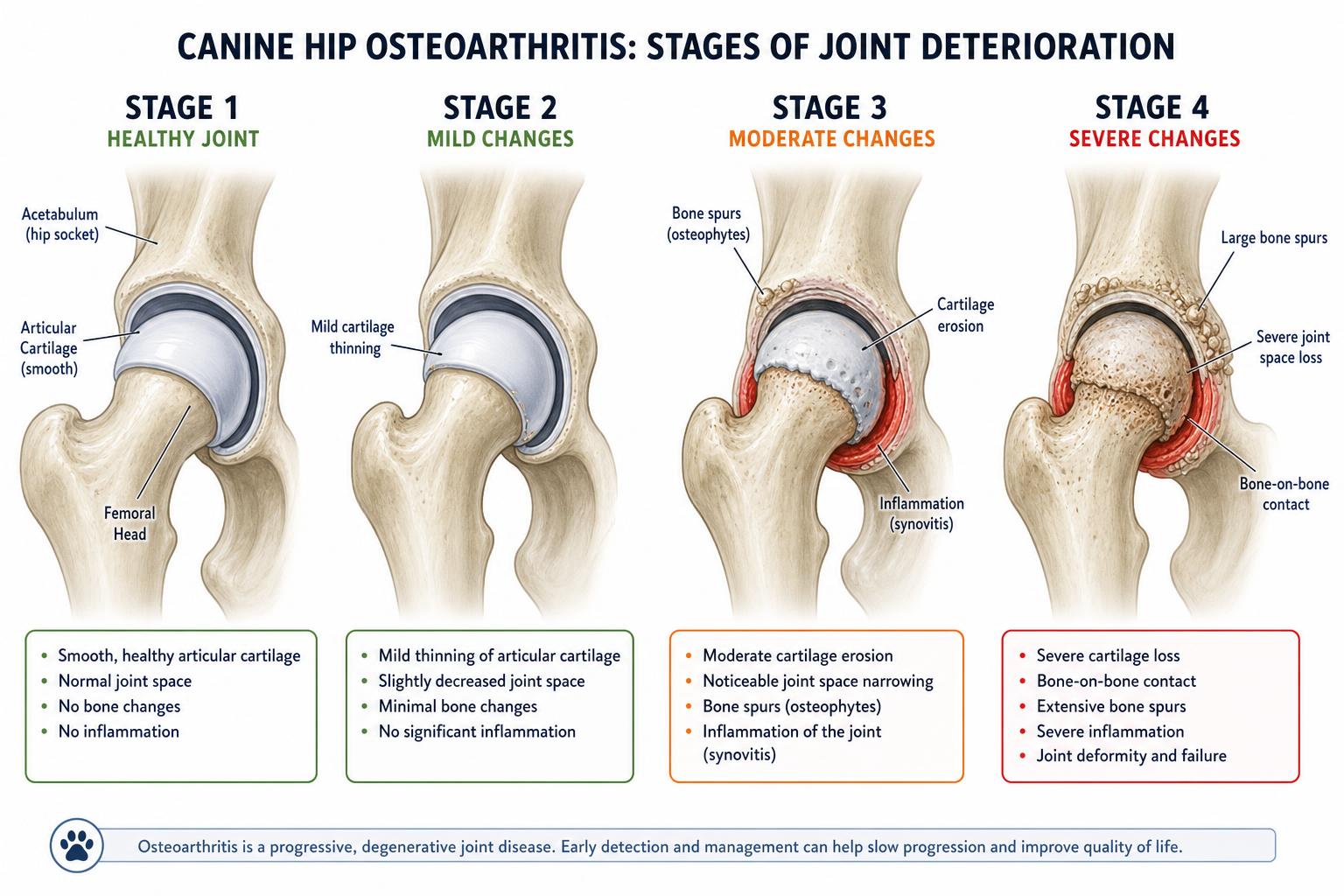
The 4 Stages of Canine Joint Deterioration
Every senior dog parent needs to understand this timeline. It's the single most important piece of information your vet probably hasn't fully explained to you — not because they don't care, but because there are 14 things to cover in a 20-minute appointment and joint health usually loses out to vaccines, dental, weight, and bloodwork. Here's the part that matters: the prevention window closes at different points for different interventions.
Stage 1 — Subclinical Cartilage Thinning (Ages 4-7 for most breeds)
Your dog looks completely normal. Plays normal. Runs normal. Underneath the surface, microscopic cartilage thinning has begun in the weight-bearing joints — hips, knees, elbows, lower spine. There is no limp, no stiffness, no clinical symptom whatsoever.
This is the optimal stage for prevention. Glucosamine, chondroitin, MSM, Omega-3s, and a few other targeted compounds can measurably slow the rate of cartilage degradation. The supporting research on multi-pathway joint nutrition at this stage is now well-established in veterinary literature.
And yet — almost no owners start supplementation at this stage. There are no symptoms to motivate action, so action doesn't happen.
Stage 2 — Mild Inflammation, Subtle Behavioral Changes (Ages 6-9)
Now things you can actually notice begin to appear. A small hesitation before jumping into the car. A slower climb up the stairs. Lying down a little more carefully than before. Less interest in the long walk. Owners almost universally dismiss these signs as 'just aging'.
They aren't "just aging." They are early-stage osteoarthritis. At Stage 2, supplementation still helps significantly — but the formulation needs to include anti-inflammatory ingredients like Boswellia Serrata, Turmeric, and Omega-3 fish oil, because cartilage support alone is no longer enough.
Stage 3 — Moderate Osteoarthritis, Visible Mobility Issues (Ages 8-11)
This is when most owners come in. The limp is now visible. The dog refuses stairs, can't jump onto the couch, may cry out when touched in the hip area. The pain is real and constant.
At this point, vets reach for NSAIDs — Carprofen, Meloxicam, Galliprant. They work. But chronic NSAID use carries serious cumulative risks: liver damage, kidney damage, GI ulceration. We have to monitor bloodwork every 3-6 months. And here's the part that breaks owners' hearts when they finally understand it: the damage they're trying to prevent has already happened. We're managing pain now, not preserving function.
Stage 4 — Severe Joint Failure (Ages 10+)
This is Toby's stage. The cartilage is essentially gone. Bone grinds on bone. Bone spurs form. The joint capsule itself becomes chronically inflamed. Movement of any kind hurts.
At Stage 4, the only options that meaningfully restore function are surgical: total hip replacement, FHO, TPLO. But surgery is expensive, invasive, and not always successful— especially in dogs whose organs have been chronically managing NSAID exposure for years.
"By Stage 4, we're not talking about prevention anymore. We're talking about damage control. And damage control has a price tag most owners can't afford."
This is the stage where dogs are euthanized for joint failure. Not because nothing could have been done — but because by the time the options became clear, the affordable, gentle, preventive options were already off the table.
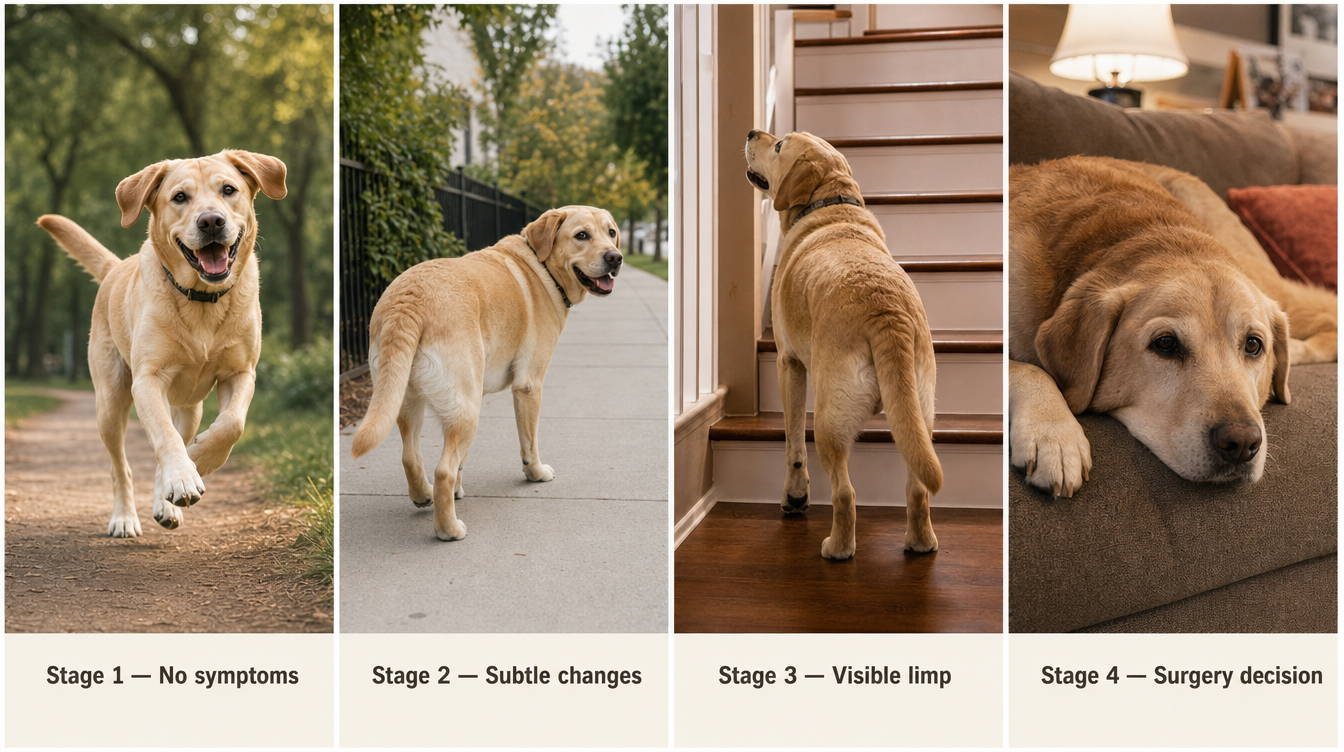
The Money Pit: What Doing Nothing Actually Costs
Let's talk about the part no one wants to talk about. Because the emotional cost of watching your dog suffer is one thing — and it is, frankly, the part that should matter most — but the financial cost is also crushing, and it's something owners don't see until they're already in it.
The cost of not preventing joint deterioration is measured in thousands of dollars per year, often for the last 2-4 years of a dog's life. Here's what that actually looks like in itemized form:
The Hidden Cost of Late Joint Care
- Chronic NSAID prescription$60–$120 per month, indefinitely
- Monthly bloodwork (liver/kidney monitoring)$80–$150 per month
- Pet pain consultation specialist$200–$400 per visit · 4–6 visits/year
- Adjunctive pain management (gabapentin, etc.)$40–$80 per month additional
- TPLO surgery (knee)$3,500–$5,500 per leg
- FHO surgery (hip)$1,500–$3,000 per hip
- Total Hip Replacement$5,000–$8,000 per hip
Average lifetime cost of Stage 3–4 joint disease management for a 10-year-old senior dog: $8,000 to $18,000.
Compare that to the cost of a quality joint supplement started at Stage 1: $25–$35 per month, for life.
The math here is brutal. The owners who hesitate to spend $30 a month on prevention end up spending $200–$700 a month on management — and then thousands more on surgery if it's not too late.
Free shipping over $50 · 30-Day Money-Back · Cancel Anytime
Why Most Joint Supplements Still Fail at Slowing the Timeline
Here's where I have to call out my own industry — including the pet-store brands and the two big "vet recommended" names you've probably already heard of.
Most joint supplements on the shelf today were formulated in the late 1990s and early 2000s, when Glucosamine + Chondroitin was considered the gold standard. The science has moved past this. The industry has not.
Multiple peer-reviewed canine studies over the last decade have shown that formulations including Boswellia Serrata and Turmeric showed significantly better mobility outcomes than glucosamine alone. The reason is mechanistic: glucosamine and chondroitin support cartilage structure; Boswellia and Turmeric address the inflammatory cascade that destroys it. You need both pathways supported simultaneously.
Yet if you read the labels of the top-selling joint chews, Boswellia and Turmeric are almost always absent. Why? Cost. A brand can save $2–$4 per bottle by leaving them out — and most consumers won't notice because the label still says "joint support."
"Industry insiders know this. They just hope you don't."
Free shipping over $50 · 30-Day Money-Back · Cancel Anytime
What I Recommend to Every Senior Dog Patient Now
After Toby, I rebuilt my entire approach to preventive joint care in my practice. I went through every joint product on the U.S. market that I could find. I cross-referenced ingredient panels against the current literature. I looked for products that included the full multi-pathway formulation, manufactured in cGMP facilities, with transparent dosing and no proprietary blends hiding sub-clinical amounts.
The brand I now recommend is Wuffbytes Hip & Joint Soft Chews.
Wuffbytes Active Ingredients (per chew)
- Glucosamine HCl — 300 mg
- Chondroitin Sulfate — 200 mg
- MSM — 150 mg
- Green Lipped Mussel (concentrated) — 75 mg
- Omega-3 Fish Oil — 75 mg
- Boswellia Serrata Extract — 50 mg
- Turmeric Extract — 25 mg
- Hyaluronic Acid — 10 mg
- Vitamin C — 10 mg
- Manganese — 2 mg
Note the two ingredients highlighted. Those are the two most popular brands skip.

Free shipping over $50 · 30-Day Money-Back · Cancel Anytime
What Happened to the Patients I Switched
I've been recommending Wuffbytes specifically for about 14 months now to dogs entering Stage 1 and Stage 2 in my practice. The pattern has been remarkable.
In the dogs I started before any clinical symptoms appeared, roughly 78% are still showing zero mobility regression two checkups later. That's nearly triple the response rate I was getting from the older glucosamine-only products.
In the dogs I switched at early Stage 2 — already exhibiting mild stiffness — about 60% showed measurable improvement in willingness to climb stairs, jump, and resume normal play within 60–90 days. And critically, we've been able to reduce or eliminate NSAID dosing in a significant portion of these dogs, which protects their organ function long-term.
The dogs already at Stage 3 and 4 saw improvement too, but the gap was much smaller. The earlier the start, the bigger the effect. This is why early intervention matters so much.
Real Senior Dogs Whose Owners Acted in Time

Sarah W., 34, Charlotte, NC
With Lola, 8-year-old French Bulldog
"Lola couldn't get up the stairs without me lifting her back end. Six weeks in, she was jumping on the bed at night by herself again. Frenchies are notorious for hip issues — this is the only thing that's actually helped."
Mike R., 49, Phoenix, AZ
With Apollo, 10-year-old German Shepherd
"Apollo is a retired K9 — Shepherds get hit hardest with hip dysplasia. Three months on this formula and he's chasing squirrels in the yard like he did at four. I wish I'd known about this two years ago."
Diane S., 56, Tampa, FL
With Pretzel, 9-year-old Mini Dachshund
"I almost didn't try this for Pretzel because I thought it was for big dogs. I broke a chew in half and started anyway. Three weeks later she was demanding her morning walk again. Don't let breed size fool you."
Greg M., 44, Salt Lake City, UT
With Cooper, 9-year-old Labrador
"Cooper had been on carprofen for almost a year and his bloodwork was getting concerning. Six weeks on this supplement, we'd weaned him off the prescription entirely with the vet's blessing. He's running trails with me again."
Free shipping over $50 · 30-Day Money-Back · Cancel Anytime
Frequently Asked Questions
My dog still seems totally fine. Is it really worth starting now?
Yes. In fact, this is the ideal window. The dogs who benefit most from quality joint supplements are the dogs whose owners start them before any visible signs. Once limping appears, you've already lost years of cartilage you can't get back.
What if my dog doesn't like the chews?
Wuffbytes offers a 30-day money-back guarantee, so you can return it if your dog refuses them. In my practice, refusal is rare — the chicken flavoring is one of the most palatable on the market.
My dog is already on Carprofen / Meloxicam. Can he take this too?
Yes, in almost all cases, but coordinate with your vet. Multi-pathway joint support is often used alongside NSAIDs to reduce the dose needed over time and protect long-term organ function.
How quickly will I see results?
Most owners see improved willingness to move within 4–8 weeks. Cartilage-level changes take 3–6 months. The single biggest predictor of outcome is how early you start.
My dog is already at Stage 3 or 4. Is it too late?
It's not too late to help, but expectations need to be honest. What a quality joint supplement can do is slow further deterioration, reduce inflammation, and often allow your vet to reduce NSAID exposure. What it cannot do is regrow cartilage that's already gone.
My Final Thoughts After 15 Years of Watching This Happen
I've seen hundreds of dogs in Toby's situation over my career. Not one of them got there because their owners didn't love them. Every single owner loved their dog. They just started too late. They waited for symptoms. They waited for "the right time." They waited for their vet to say it more directly than the vet did.
So I'm saying it directly: If your senior dog is over age 6 and isn't on a quality multi-pathway joint supplement yet — start one this week. Not next month. Not after the holidays. This week.
If your dog is younger — age 3 to 5 — and you have a high-risk breed (Labrador, Golden, German Shepherd, Rottweiler, Bernese, Mastiff, any large or giant breed), the same answer applies. The prevention math is overwhelming. You will not regret early prevention. You may very much regret waiting.
"I know what you're thinking — 'my dog is fine, he's still active, this doesn't apply to me yet.' That's exactly what Patricia thought about Toby when he was 7. The dogs I watch deteriorate fastest are usually the ones whose owners thought they had more time."
The window is smaller than you think.
The cost of being early is $30 a month. The cost of being late is $8,000 to $18,000 — and sometimes everything.
Don't be Patricia in 2027.
Last Chance — Founding Member Pricing
Wuffbytes is currently offering Founding Member pricing for new customers: 25% off Subscribe & Save, plus free shipping over $50, plus a 30-day money-back guarantee.
If you've read this far, you already know what you need to do.
Free shipping over $50 · 30-Day Money-Back · Cancel Anytime
Dr. James Patrick, DVM, has practiced small-animal veterinary medicine for 15 years with a clinical focus on geriatric mobility and orthopedic preventive care. He contributes regularly to Vet Watch Insider as part of its independent veterinary advisory board.